CNC machining prices rarely come from a single hourly rate. They reflect material choice, geometry, tolerances, quantity, setup time, programming, inspection, finishing, and delivery requirements. A simple aluminum bracket may need one setup and standard tooling. A tight-tolerance steel housing may require several operations, custom fixtures, and documented inspection.
So, what affects CNC machining pricing? Labor remains important. The U.S. Bureau of Labor Statistics’ Occupational Employment and Wage Statistics provides wage benchmarks for machinists, machine tool operators, and related production roles. These figures help explain regional labor differences, but they do not represent a complete shop rate. Rent, maintenance, software, quality systems, utilities, and machine depreciation also enter the calculation.
Machine investment matters. Gardner Business Intelligence’s World Machine Tool Survey consistently tracks the high capital value of modern manufacturing equipment and global machine-tool demand. Five-axis equipment can reduce repositioning, yet its hourly cost may be higher. Programming and automation can improve repeatability, although the savings depend on batch size and part stability. Deloitte’s 2024 Smart Manufacturing and Operations Survey also highlights the growing role of digital systems, connected equipment, and operational efficiency in manufacturing decisions.
Material waste is another visible cost. A billet that weighs three kilograms may produce a much lighter finished part. Chips still require handling. Tool wear can also change during a long run. That shortcut is tempting. It is not always right. Supplier quotes should therefore separate setup, machining, material, finishing, inspection, and shipping. The following ten factors explain where each cost appears, while recognizing that real pricing still depends on drawings, quantities, location, and supplier capability.
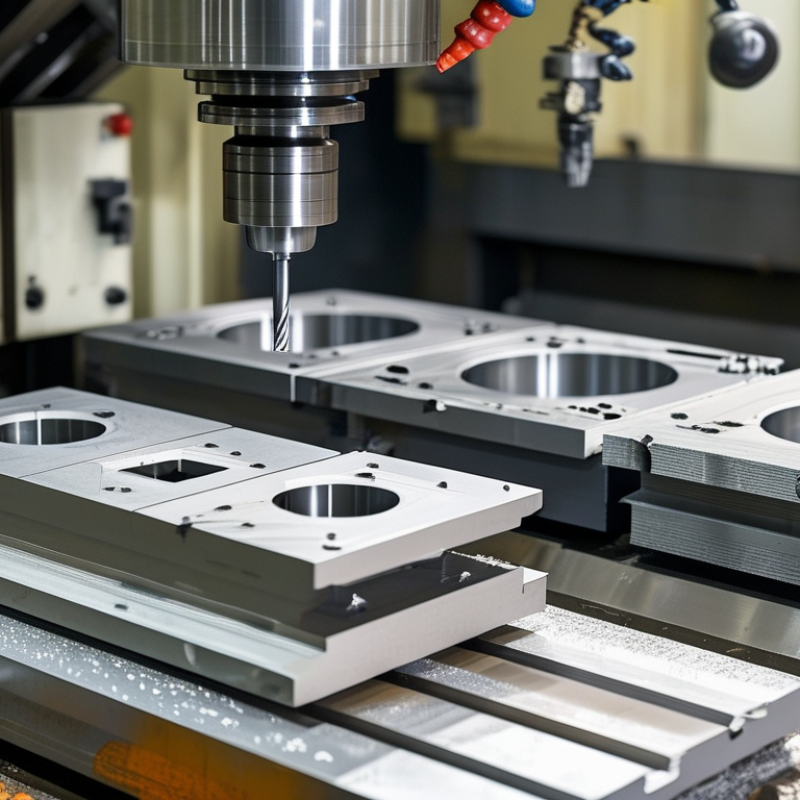
CNC machining prices often begin with machine-hour economics. Typical shop rates range from $50 to $150 per hour, depending on equipment, region, and production demands. That hourly number is not profit.
A three-axis machine may cost less than a five-axis system. Advanced equipment carries higher maintenance, programming, tooling, and calibration expenses. Labor also matters. An experienced machinist may spend 45 minutes aligning a fixture before cutting begins. The spindle may run for only 20 minutes, but the customer still pays for preparation time.
Ten pricing factors usually shape the final quote: material, part size, geometry, tolerances, surface finish, quantity, setup time, programming, tooling, and inspection. Stainless steel can slow cutting and increase tool wear. Tight tolerances may require temperature control and additional measurements. A simple aluminum bracket might need one setup, while a complex housing could need several orientations.
Small details matter. A deep pocket may require special tooling. A low-volume order can carry a higher unit price because setup costs spread across fewer parts. In my early estimates, I treated cutting time as the main expense. That was too optimistic. Rework, machine downtime, and inspection can quietly change the result. Reliable quoting requires actual shop records, realistic cycle times, and a clear review of every drawing note.
Material choice strongly influences CNC machining pricing. 6061 aluminum weighs less, cuts quickly, and usually requires lower spindle loads. Its density is 2.70 g/cm³, making large parts easier to handle. Titanium reaches 4.43 g/cm³ and demands more controlled cutting conditions. It also generates substantial heat near the cutting zone. That heat can shorten tool life and increase machining time.
Density alone does not determine the final quote. A titanium block may cost more because suppliers use slower feeds, stronger fixtures, and frequent tool changes. Operators may also leave extra material for finishing. That assumption needs checking.
For a simple bracket, aluminum may finish in minutes with limited setup. A titanium aerospace-style housing can require several operations, tight workholding, and careful inspection. Deep pockets create another difference. Aluminum chips usually evacuate more easily, while titanium chips may damage tools when cooling is poor. Material waste also matters. A dense, expensive billet can make failed parts more costly.
In my machining experience, customers often compare kilogram prices first. That comparison is incomplete. The drawing, tolerance, batch size, and surface requirements can change the result dramatically. A lighter aluminum part is not always cheaper when it needs complex finishing. Likewise, titanium can become reasonable for small, high-strength components. Request a quote using the exact alloy, blank size, geometry, tolerance, and expected quantity. Guessing from density alone often creates an unreliable budget.
Machining complexity strongly influences CNC pricing, especially when comparing three-axis and five-axis workholding. A three-axis job often uses a standard vise, simple datum setting, and one or two setups. A five-axis part may require custom soft jaws, a tombstone, probing, and collision verification. Each extra setup adds fixture labor, inspection time, and the risk of losing positional accuracy.
The difference becomes visible in the toolpath. Three-axis programming usually follows predictable planar movements. Five-axis programming must control tool orientation, clearance, rotary limits, and surface quality. More sophisticated software and experienced programmers are therefore required.
According to the 2023 U.S. machine-tool orders report, manufacturers purchased roughly 26,000 units valued near 5 billion dollars. That capital burden eventually affects hourly machining rates. A five-axis machine also carries higher maintenance and training costs.
One setup can save money.
However, five-axis is not automatically cheaper. For a shallow aluminum bracket, three-axis machining may finish faster with inexpensive workholding. For a deep aerospace-style housing, five-axis access can reduce four setups to one. That may lower labor and improve consistency, even with a higher machine rate.
ISO 230-2 testing principles also remind engineers that machine accuracy must be verified, not assumed. A practical quote should separate programming, fixture design, cutting time, inspection, and rework risk. Many estimates still underprice setup creativity. That is where experienced review matters.
Top 10 Factors That Affect CNC Machining Pricing?
Tolerance and surface finish strongly influence CNC machining prices. ASME Y14.5 defines how dimensions, datums, and geometric tolerances should be interpreted. A tight profile or position tolerance may require multiple setups and detailed inspection. Standard dimensions usually cost less to produce.
A Ra 1.6 μm surface finish needs controlled cutting conditions. Tool sharpness, feed rate, material hardness, and machine stability all matter. Machinists may use a finishing pass, smaller stepovers, or secondary polishing. These operations increase cycle time. They also create more opportunities for variation. Ra is an average roughness value, not a guarantee of visual perfection. A part can meet Ra 1.6 μm and still show tool marks.
Tips: Specify only necessary tolerances. Use ASME Y14.5 symbols clearly, and identify critical surfaces. Request a realistic inspection method before production. A surface-finish note without measurement direction can cause confusion. In practice, even careful drawings sometimes over-control noncritical areas. That mistake raises pricing without improving function.
Inspection costs also affect the quote. Tight tolerances may require a coordinate measuring machine, calibrated gauges, or sampling plans. Temperature can influence measurements on larger parts. Material movement after machining may create unexpected results. Discuss these risks early. A clear drawing, suitable datum structure, and practical Ra requirement usually support a more reliable price.
| Rank | Pricing Factor | Typical Engineering Range or Requirement | Typical Cost Impact | Why It Changes the Price | Recommended Drawing or Planning Practice |
|---|---|---|---|---|---|
| 1 | Dimensional Tolerance | General CNC tolerance: approximately ±0.10 to ±0.13 mm; precision features: approximately ±0.02 to ±0.05 mm; highly restrictive features may require approximately ±0.01 mm or tighter. | High | Tighter limits require better machine capability, controlled cutting conditions, additional inspection, and sometimes multiple finishing passes. | Apply tight tolerances only to functional features. Use general tolerances for non-critical dimensions. |
| 2 | Surface Finish Requirement | Typical milled finish: Ra 3.2–6.3 μm; fine-machined finish: Ra 1.6 μm; higher-finish machining: Ra 0.8 μm or below. | High | Ra 1.6 μm may require reduced feed rates, sharper tools, finishing passes, tool changes, and controlled measurement. | Specify Ra only where needed and identify the surfaces that require the finish. |
| 3 | GD&T and Positional Accuracy | Geometric controls may include position, flatness, perpendicularity, parallelism, profile, and runout according to ASME Y14.5. | High | Datums, fixtures, coordinate measuring equipment, and additional setups may be required to verify relationships between features. | Define functional datums and avoid duplicating or over-constraining geometric controls. |
| 4 | Material Type and Machinability | Aluminum and free-machining steels generally cut faster than hardened steels, titanium alloys, nickel alloys, or abrasive composites. | High | Hardness, thermal conductivity, work hardening, and abrasiveness affect cutting speed, tool life, coolant requirements, and cycle time. | Specify the exact material grade and condition, including hardness or heat-treatment requirements. |
| 5 | Part Geometry and Complexity | Deep cavities, thin walls, narrow slots, small internal radii, undercuts, and complex 3D surfaces increase programming and machining difficulty. | High | Complex geometry can require smaller tools, longer cycle times, multi-axis machining, special workholding, or additional inspection. | Use the largest practical internal radii and avoid unnecessary deep pockets or very thin walls. |
| 6 | Material Removal and Stock Size | Large billet-to-part volume ratios, thick starting stock, and substantial pocketing increase cutting time and material waste. | Medium to High | More stock removal increases spindle time, tool wear, chip handling, and the risk of distortion or residual stress. | Consider near-net stock, blanks, castings, forgings, or pre-machined stock when appropriate. |
| 7 | Number of Setups and Workholding | One-sided prismatic parts may use one setup; multi-sided parts may require two or more setups or custom fixtures. | Medium to High | Each setup adds fixturing, alignment, probing, datum transfer, programming, and inspection time. | Design features so that as many operations as possible can be completed in fewer setups. |
| 8 | Order Quantity and Batch Size | Prototype and one-off parts carry a higher setup and programming cost per part; larger batches distribute these costs across more pieces. | Medium | Programming, tooling, fixture preparation, and first-article inspection are relatively fixed costs. | Provide the expected quantity and repeat-order forecast when requesting a quotation. |
| 9 | Inspection and Documentation | Basic dimensional inspection is less demanding than full GD&T verification, material certification, capability studies, or a detailed inspection report. | Medium | Inspection time rises with the number of characteristics, required accuracy, measurement method, and reporting requirements. | Identify critical characteristics and specify the required inspection records before production. |
| 10 | Secondary Operations and Delivery Time | Common secondary operations include deburring, anodizing, plating, heat treatment, grinding, laser marking, and expedited production. | Low to High | Outside processing, special handling, queue priority, and accelerated scheduling can add direct cost and coordination time. | Separate machining, finishing, inspection, packaging, and delivery requirements on the purchase specification. |
| Requirement Category | Common Value | Manufacturing Interpretation | Approximate Relative Pricing Index* |
|---|---|---|---|
| General dimensional tolerance | ±0.10 to ±0.13 mm | Suitable for many non-critical CNC dimensions when the drawing allows a general tolerance. | 1.00× |
| Moderate precision tolerance | ±0.05 mm | Usually requires improved process control and more careful inspection than general machining. | 1.10–1.25× |
| Tight precision tolerance | ±0.02 mm | May require controlled temperature, stable workholding, finishing passes, and enhanced measurement. | 1.25–1.60× |
| Very tight tolerance | ±0.01 mm or tighter | Often requires specialized process planning, high-resolution inspection, and possible secondary finishing. | 1.60× or higher |
| Standard machined surface | Ra 3.2–6.3 μm | Commonly achievable with ordinary roughing and finishing operations, depending on material and geometry. | 1.00× |
| Fine machined surface | Ra 1.6 μm | Typically needs a dedicated finishing pass, suitable tooling, controlled feed rate, and surface verification. | 1.10–1.35× |
| Very fine machined surface | Ra 0.8 μm | May require additional finishing operations, optimized toolpath strategy, or grinding depending on the material. | 1.25–1.60× |
| Ultra-fine surface | Ra 0.4 μm or below | Often requires specialized finishing, grinding, polishing, lapping, or tightly controlled process conditions. | 1.50× or higher |
Batch size often changes the unit price more than the material does. Setup time includes programming, workholding, tool offsets, and first-piece checks. A fixture costing $300 adds $30 per part across ten pieces, but only $0.30 across one thousand. The U.S. Bureau of Labor Statistics reported a median annual wage of $48,550 for machinists in May 2023. That labor cost continues during setup, even when the spindle is idle. Small batches therefore carry heavier preparation costs.
Inspection can produce another sharp difference. A single prototype may need complete dimensional verification, material certificates, and a detailed report. Repeated production may use sampling, unless risk or customer requirements demand more checks. Tight tolerances also slow machining and increase tool wear. Lead time matters, too. Rush work can require overtime, rescheduling, or premium material delivery. The actual quotation is not always elegant. Some estimates miss hidden rework.
Tips: Ask for setup, machining, inspection, and delivery costs separately. Request pricing at three quantities. For example, compare 10, 100, and 1,000 parts. Share the CAD model, drawing tolerances, surface finish, material grade, and inspection expectations. According to the 2023 BLS wage data, labor remains a measurable cost, not a minor detail. Still, labor rates vary by region and skill. Treat published figures as a reference, not a promise. Batch savings can disappoint when designs change between orders.
Typical shop rates range from $50 to $150 per machine hour. That is not pure profit. Equipment, labor, maintenance, programming, tooling, and calibration affect the rate.
A machinist may spend 45 minutes aligning a fixture before cutting starts. The spindle might run for only 20 minutes. Setup labor still counts.
Material, part size, geometry, tolerances, finish, quantity, setup, programming, tooling, and inspection all matter. Small details can change everything. A deep pocket may require special tools.
Stainless steel can slow cutting and increase tool wear. It may require careful feeds, sharper tools, and longer cycle times. The effect varies by grade.
Tight tolerances may require extra setups, temperature control, and repeated measurements. Larger parts can move slightly as temperatures change. That risk is easy to underestimate.
No. Ra 1.6 μm describes average roughness, not perfect visual appearance. Tool marks may still appear. Finishing passes or polishing can increase cost.
Setup costs spread across more parts in larger batches. A $300 fixture adds $30 per part across ten pieces. Across one thousand pieces, it adds only $0.30 each.
Prototypes may require complete measurements, material records, and detailed reports. Repeat production may use sampling. Critical tolerances can require calibrated gauges or coordinate measurement equipment.
Provide the drawing, three-dimensional model, material grade, tolerances, finish, quantity, and inspection expectations. Ask for separate setup, machining, inspection, and delivery costs. Compare ten, one hundred, and one thousand parts.
Cutting time is only one expense. Rework, downtime, tool wear, and hidden drawing requirements can quietly increase costs. I once treated cutting time as the main expense. That was too optimistic.
Understanding what affects CNC machining pricing starts with the relationship between machine time, material, and production requirements. Typical CNC machine rates may range from $50 to $150 per hour, so longer cutting cycles, complex toolpaths, and additional operations can quickly increase costs. Material choice also matters: 6061 aluminum has a density of approximately 2.70 g/cm³ and is generally easier to machine, while titanium, at about 4.43 g/cm³, may require slower cutting speeds, specialized tooling, and more machining time.
Part complexity is another major factor. A 3-axis job may be more economical than a 5-axis project requiring advanced workholding and carefully planned toolpaths. Tight tolerances based on ASME Y14.5 and surface finishes such as Ra 1.6 μm can add inspection, finishing, and process-control expenses. Finally, setup time, order volume, inspection needs, and delivery schedules strongly influence unit price. Larger batches distribute setup costs across more parts, while urgent lead times or demanding quality checks may increase the overall quotation.

Robotic CNC