Choosing between CNC and manual machining begins with a practical question: what is the difference between CNC and manual machining? The answer involves more than machine appearance. It concerns control, repeatability, speed, operator skill, and production goals. A CNC machine follows coded instructions to cut metal with programmed movements. A manual mill depends on an operator turning handwheels, reading scales, and judging cutting conditions. That human judgment can be valuable, especially during repairs, prototypes, and one-off parts.
John Saunders, a CNC educator and machinist, explains the principle clearly: “The machine follows the program, but the programmer defines the result.” This statement reflects real workshop experience. A CNC machine may produce identical aluminum brackets all day, but poor tooling data can still create chatter, burrs, or incorrect holes. Manual machining can also deliver excellent accuracy when an experienced machinist checks each dimension carefully. It is slower, though. Sometimes much slower.
For China CNC machining projects, the better choice depends on quantity, geometry, tolerance, material, and delivery expectations. CNC machining suits repeated parts, complex contours, and documented quality control. Manual machining may suit simple shafts, quick modifications, and early prototypes. The comparison is not completely absolute. A skilled workshop often uses both methods. That is where this discussion becomes more realistic. CNC technology improves consistency, but it does not remove the need for engineering judgment, inspection, and honest process evaluation.
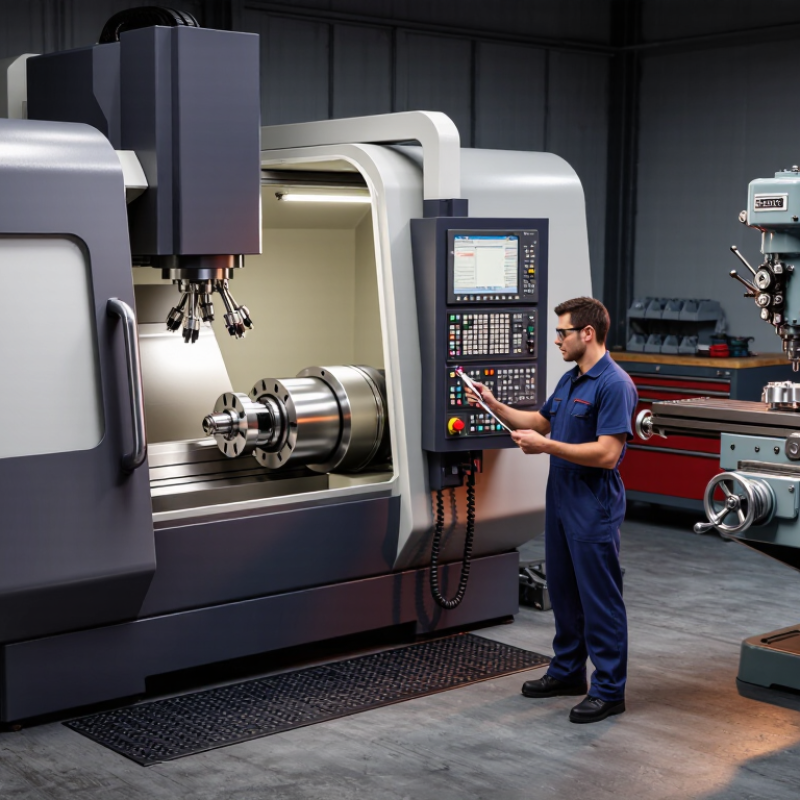
CNC machining is a manufacturing process controlled by programmed computer instructions. CNC means Computer Numerical Control. A digital design guides the machine’s movements, cutting tools, spindle speed, and feed rate. The machine can mill, drill, turn, or carve materials such as aluminum, steel, and engineering plastics.
It starts with a CAD model and manufacturing plan. CAM software converts the design into toolpaths and machine code. After setup, an operator secures the workpiece, loads the tools, and checks the program. Small details matter. Tool offsets, material hardness, and clamping pressure can change the final size. Experienced operators inspect the first part with calipers, micrometers, or coordinate measuring equipment. That practical check remains essential.
Compared with manual machining, CNC machining offers repeatable production and efficient complex cutting. Manual machines depend more heavily on handwheels, operator judgment, and direct measurement. CNC is not automatic perfection. A wrong coordinate can produce many incorrect parts quickly. I have seen planning treated as a minor task, yet it often decides the result. Careful simulation, tool maintenance, and documented inspections improve reliability. Some jobs still benefit from manual adjustment, especially prototypes, repairs, or simple one-off parts. The best method depends on tolerance, quantity, geometry, and available skill.
Manual machining relies on an operator’s judgment, hand control, and practical experience. Unlike CNC machining, it does not follow a fully automated program. The machinist reads the drawing, selects cutting tools, and adjusts each movement directly.
A handwheel turns the table or cutting tool. The sound of the cut can reveal vibration, tool wear, or poor alignment. Small adjustments matter. A few extra turns may ruin a tight tolerance. In a workshop, manual machining is useful for prototypes, repairs, and simple parts. It also helps new machinists understand cutting forces before operating complex equipment.
Manual machines can produce accurate results, but accuracy depends heavily on skill and machine condition. Temperature, measurement habits, and tool sharpness all affect the final part. CNC machining usually offers better repeatability for large production runs. Manual work can be faster for one-off changes, especially when programming would take longer than the cut itself.
There is no perfect choice. Manual machining feels flexible, yet it can be tiring and inconsistent. CNC machining feels controlled, yet a wrong program may repeat the same mistake many times. I would not treat either method as automatically superior. Careful inspection remains necessary, even when the surface looks correct.
CNC and manual machining differ most in control, repeatability, and operator involvement. A CNC machine follows programmed coordinates, cutting aluminum or steel with consistent tool paths. Manual machining depends on handwheels, visual judgment, and constant adjustment. The difference becomes clear when producing 200 identical brackets. CNC keeps dimensions stable, while manual work may slowly drift as tools wear.
Deloitte’s 2024 Smart Manufacturing and Operations Survey reports that 86% of manufacturers view smart manufacturing as essential to competitiveness within five years. That figure supports CNC adoption, but it does not make manual machining obsolete. Manual equipment remains practical for repairs, prototypes, and one-off parts. It also helps machinists understand cutting forces, chatter, and workholding through direct feedback. Small details matter. A loose fixture can ruin either process. The U.S. Bureau of Labor Statistics continues to identify machinists and tool-and-die makers as skilled production occupations, reflecting the human expertise still required. CNC reduces repetitive input, not responsibility. Programming errors, incorrect offsets, and poor inspection can produce a full batch of accurate-looking failures. That risk is often underestimated. CNC is usually stronger for volume and repeatability; manual machining can be faster for simple, urgent adjustments. The best choice depends on tolerance, quantity, material, and available skill. Even experienced teams may choose differently after testing the first part.
| Comparison Dimension | CNC Machining | Manual Machining | Practical Consideration |
|---|---|---|---|
| Operating Method | A computer-controlled machine follows programmed toolpaths and coordinates. | An operator controls the machine using handwheels, levers, and manual settings. | CNC reduces dependence on continuous hand control, while manual work relies more heavily on operator skill. |
| Best Production Volume | Well suited to repeat production, prototypes, and medium-to-high volumes. | Often suitable for one-off parts, repair work, maintenance, and very small batches. | CNC setup time can be distributed across many parts; manual machining can be economical for simple individual jobs. |
| Repeatability | Generally high when the program, tooling, workholding, and machine condition are controlled. | Can vary from part to part because dimensions depend on manual adjustments and operator technique. | CNC is usually the safer choice when many interchangeable parts are required. |
| Dimensional Accuracy | Can achieve tight tolerances when supported by suitable equipment, tooling, inspection, and process control. | Can produce accurate parts, but achievable results are more dependent on operator experience and machine setup. | The drawing tolerance, material, geometry, machine condition, and inspection method determine the actual result. |
| Complex Geometries | Handles complex profiles, pockets, contours, drilling patterns, and multi-axis features more efficiently. | Most effective for straightforward turning, milling, drilling, facing, and fitting operations. | CNC is advantageous when a part has repeated curves, multiple coordinated axes, or difficult-to-reach features. |
| Programming Requirement | Requires part programming, toolpath planning, setup instructions, and program verification. | Usually requires less or no formal numerical-control programming for simple operations. | CNC programming adds preparation work but supports repeatable production once validated. |
| Setup Time | May require workholding, tool offsets, program loading, and first-piece verification. | Often faster to begin for simple, familiar jobs, although complex manual setups can also take time. | The preferred method depends on whether setup time is offset by the quantity and complexity of the parts. |
| Production Speed | Maintains consistent cutting cycles and can perform several operations with limited manual intervention. | Speed depends strongly on the operator and may be slower for repeated or multi-step operations. | CNC generally provides greater throughput for repeat work. |
| Labor Requirement | Needs skilled programmers, setup technicians, machinists, and quality personnel as required. | Requires a machinist to control and monitor the cutting process directly. | CNC changes the skill profile; it does not eliminate the need for experienced machining personnel. |
| Surface Finish Control | Provides consistent feed rates, spindle speeds, and toolpaths when correctly programmed. | Can achieve good finishes, but consistency depends more on manual control and operator technique. | Material, cutter condition, rigidity, coolant, and cutting parameters affect the final finish in both methods. |
| Design Changes | A revised digital model or program can be used to update the machining process. | Changes are made through new manual settings, measurements, and machining adjustments. | CNC is often more convenient when design revisions occur frequently or involve complex features. |
| Initial Investment | Usually requires a higher investment in machine tools, software, tooling, training, and maintenance. | Typically has lower equipment and programming costs for basic machining tasks. | Investment should be evaluated against expected volume, tolerance, complexity, and labor cost. |
| Flexibility for Repairs | Flexible for repeatable repair components when a model or program is available. | Often convenient for quick alterations, fitting, and on-the-spot adjustments. | Manual machining can be practical for urgent, simple repairs; CNC is valuable for accurate replacement parts. |
| Typical Choice | Complex parts, repeat orders, tight consistency requirements, and multi-operation production. | Simple parts, one-off work, maintenance tasks, quick modifications, and low-volume jobs. | Many modern workshops use both methods and select the process based on part requirements. |
Note: Actual accuracy, tolerance, cycle time, cost, and surface finish depend on the machine, material, tooling, workholding, programming, operator skill, and inspection procedure.
CNC machining uses computer-controlled tools to produce repeated parts with consistent dimensions. It suits complex profiles, tight tolerances, and medium or large production runs. Once the program is verified, the machine can follow the same toolpath for many hours. This reduces variation between parts. It does not remove risk. Incorrect coordinates, worn cutters, or poor workholding can still ruin an entire batch.
Manual machining depends directly on an operator’s judgment and hand control. It works well for repairs, prototypes, simple shafts, and one-off components. A skilled machinist can adjust cutting speed after hearing vibration or seeing a rough surface. That response is valuable. However, manual production usually takes longer and may show greater dimensional variation. Operator fatigue also affects consistency, especially during repetitive work.
Cost depends on more than machine type. CNC requires programming, setup, inspection, and suitable tooling before cutting begins. Manual work may start faster for a simple part, but labor increases with quantity. In practical manufacturing, the material, tolerance, geometry, and order size should guide the decision. A simple aluminum spacer may not justify CNC setup. A complicated steel housing probably does. Even experienced teams sometimes choose poorly when they focus only on hourly rates. Careful drawings and first-piece inspection remain essential.
Choosing between CNC and manual machining starts with the part, not the machine’s price. Use CNC for pockets, contours, repeated holes, or tight positional tolerances. It also suits repeat orders because programs preserve cutting paths and reduce operator variation. A 0.02 mm positional tolerance across 500 parts usually favors CNC, provided the fixture remains stable. Grand View Research estimated the global CNC machine market at USD 83.8 billion in 2022. It projected a 10.3% compound annual growth rate through 2030. This growth reflects automation demand, but CNC is not economical for every job.
Manual machining works well for repair parts, quick modifications, and low-quantity components with accessible geometry. The operator can touch off a tool, feel a cut, and adjust immediately. CNC needs programming, workholding, tooling, and inspection time before cutting begins. For production runs, those fixed tasks can spread across many parts. No code first. The U.S. Bureau of Labor Statistics projects a 2% employment decline for machinists and tool and die makers from 2023 to 2033. It still forecasts about 34,000 annual openings. Skills remain important. A recurring shop-floor mistake is choosing CNC too early, especially when setup exceeds cutting time. For China-based sourcing, compare total cycle cost, tolerance, quantity, material, and delivery risk. Ask for a first-article inspection plan. The best choice can change mid-project.
Manual machining uses handwheels, cutting tools, and an operator’s judgment. The machinist controls each movement directly. Small adjustments matter.
It suits prototypes, repairs, simple shafts, and one-off parts. A quick modification may take minutes. Programming could take longer.
Results depend on skill, tool sharpness, temperature, and machine condition. Fatigue can increase variation during repetitive work. That risk is easy to underestimate.
CNC suits complex contours, repeated holes, tight tolerances, and larger production runs. A verified program can repeat the same toolpath for hours.
No. Incorrect coordinates, worn cutters, or unstable workholding can damage an entire batch. Consistency does not guarantee correctness.
Manual machining may be efficient for one or two simple parts. CNC setup becomes more reasonable across hundreds of parts. The break-even point changes.
CNC often provides stronger repeatability, especially around a 0.02 millimeter positional tolerance. Stable fixtures and inspection remain necessary. Accuracy is never automatic.
Compare programming, setup, tooling, labor, inspection, material, and delivery risk. A simple aluminum spacer may not justify CNC setup. A complex steel housing probably does.
Request a first-piece inspection and confirm critical dimensions. Check holes, surfaces, and alignment with suitable measuring tools. A good-looking surface can still hide errors.
CNC machining uses computer-controlled equipment to guide cutting tools with high precision, repeatability, and efficiency. It is well suited for complex designs, large production runs, and projects that require consistent results. Manual machining, in contrast, relies on an operator’s direct control of machine tools. It is often practical for simple parts, repairs, prototypes, and low-volume work where flexibility and quick adjustments are important.
Understanding what is the difference between CNC and manual machining helps manufacturers choose the right process. CNC machining can reduce human error, maintain tight tolerances, and produce multiple identical components, but it may require higher equipment costs, programming, and setup time. Manual machining generally has lower initial costs and offers hands-on control, yet production speed, consistency, and complexity may be limited by operator skill. The best choice depends on factors such as part design, required precision, quantity, budget, lead time, and the need for customization.

Robotic CNC