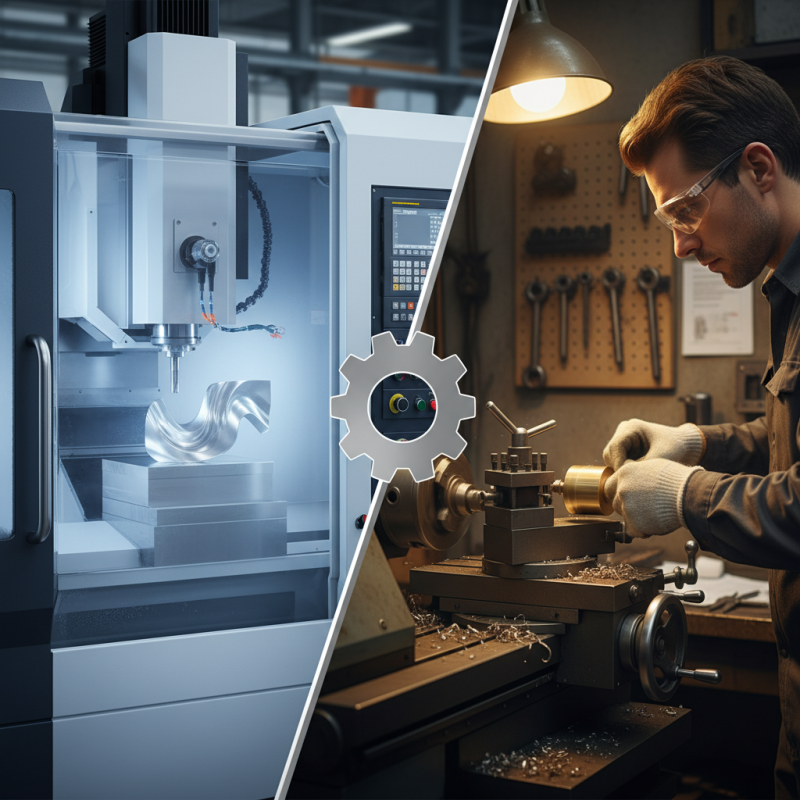
Understanding how CNC and manual machining differ is crucial for manufacturing professionals. Many people often ask, "what is the difference between CNC and manual machining?" This question highlights the evolving landscape of machining technologies. Both methods have unique advantages and challenges.
CNC machining offers precision and automation. It uses computer software to control the machinery, allowing for intricate designs and consistent outputs. This level of accuracy reduces human errors and increases efficiency. However, the initial setup costs can be significant.
On the other hand, manual machining relies on skilled operators to guide the machines. This method fosters creativity and adaptability but is prone to variability. Each operator's skill level can impact the final product. Ultimately, choosing between these methods depends on specific manufacturing needs, budget constraints, and desired outcomes.
CNC Machining: Overview and Advantages Compared to Manual Machining
CNC machining has transformed the manufacturing landscape. This technology automates the machining process using computer-controlled tools. In contrast, manual machining relies heavily on human skill and intuition. A key advantage of CNC machining lies in its precision. Reports indicate that CNC machines can achieve tolerances within 0.001 inches. Manual machining, while capable, often struggles to maintain such accuracy consistently.
Another aspect to consider is production speed. CNC machines can operate continuously and reduce production times significantly. Studies show that CNC machining can boost productivity by up to 50% when compared to manual methods. However, this advantage brings a potential downside. When machines break, they can cause significant delays. Skilled operators are required to troubleshoot and repair these machines.
CNC machining also offers design flexibility. Complex geometries that would take hours to create manually can be executed in minutes with CNC technology. Yet, this flexibility comes with a learning curve. Training operators to write code and understand the machinery can take time. While CNC machines dominate in efficiency, the human element in manual machining provides unique insights and creativity that might be overlooked in automated processes. Balancing these approaches can yield the best results.
Understanding Manual Machining: Techniques and Use Cases
Manual machining is a fundamental technique in the manufacturing sector. Many craftsmen prefer it due to the hands-on control it offers. Operators can make quick adjustments based on real-time observations. This flexibility is particularly useful for prototypes or specialized designs. Each piece can be unique, reflecting a creator's artistic touch, which is hard to replicate with machines.
In manual machining, several techniques are employed. Turning, milling, and drilling are common operations. Each method requires skill and precision. A lathe operator must understand speed and feed rates. The choice of tools significantly impacts the outcome. Operators often work from detailed drawings or sketches, interpreting dimensions with a keen eye. Mistakes can happen, leading to wasted materials. Reflecting on errors is essential for improvement in skills and techniques.
Use cases for manual machining include small batch production and repair work. Customized parts often necessitate manual methods where CNC cannot compete. For instance, a local artisan may craft unique components for a vintage vehicle. Such tasks demand intricate handwork that automated processes might overlook. The challenge lies in maintaining consistency while ensuring the highest quality across pieces.
CNC vs Manual Machining: Key Differences
This bar chart illustrates the key differences between CNC and manual machining across five important dimensions: Speed, Precision, Flexibility, Cost, and Labor Requirement. CNC machining excels in speed and precision, while manual machining is more cost-effective and requires more labor input.
Key Differences in Precision and Accuracy Between CNC and Manual Methods
CNC machining and manual machining differ significantly in precision and accuracy. CNC machines rely on computer programming, ensuring consistent results with minimal human error. Research indicates that CNC capabilities allow tolerances as tight as ±0.001 inches, while manual methods may struggle with tolerances around ±0.005 inches. This distinction impacts various industries, especially aerospace and medical, where precision is crucial.
When examining accuracy, CNC machines can replicate designs flawlessly across production runs. A study demonstrated that CNC machining reduces the variance in produced parts by up to 30%. In contrast, manual machining can lead to discrepancies due to the operator's skill level, fatigue, or oversight. As a result, businesses often face increased waste and rework when using manual methods.
Tip: Invest in training for machine operators to enhance manual machining accuracy. Even skilled workers can make mistakes, so continuous learning is essential. Consider integrating quality checks after critical machining processes, whether manual or CNC.
Despite the advantages of CNC, manual machining remains valuable. It can be more adaptable for small-scale projects or unique designs. This flexibility often comes with unpredictability in precision. Regular assessment of operators’ performance may reveal areas for improvement and lead to better output.
Cost Analysis: CNC vs Manual Machining for Different Projects
When evaluating CNC vs manual machining, cost considerations often dictate the best choice for specific projects. CNC machining can entail higher initial costs due to equipment investment. A recent industry report indicates that CNC machines can cost anywhere from $10,000 to over $100,000. However, they provide efficiency and precision that manual machining struggles to match.
Manual machining might seem more affordable initially, with equipment costs as low as $1,000. Yet, this approach often results in higher labor costs and longer production times. According to an analysis, labor can constitute up to 60% of machining costs in manual setups. Projects requiring high-volume production benefit significantly from CNC's speed and repeatability, potentially offsetting the higher setup costs.
Nevertheless, for small batch production or prototyping, manual machining may be more economical. The flexibility of manual machining can lead to cost savings when less capital is available. Yet, inconsistency in results can be a drawback, complicating quality control. Balancing these factors requires a careful examination of project requirements and budget constraints.
Impact of Technology on Workforce Skills in CNC and Manual Machining
The impact of technology on workforce skills in CNC and manual machining is significant. According to a report by the National Institute of Standards and Technology, up to 85% of manufacturing jobs now require advanced technical skills. This shift highlights the importance of training programs that focus on CNC technology. Workers must adapt to this change as automation becomes more prevalent.
CNC machining demands a unique skill set compared to manual machining. Workers need to understand programming and software tools. Many companies report a gap in skills among job applicants. A study by the Manufacturing Institute states that 600,000 manufacturing jobs remain unfilled, largely due to this skills gap. Training and education programs struggle to keep pace with advancing technologies.
However, manual machining still holds value. It requires craftsmanship and precision that machines can’t replicate. Many experienced machinists lament the declining interest in manual skills among young workers. Focusing solely on CNC can lead to a loss of essential traditional techniques. Both CNC and manual machining have their place, and a balanced skillset is crucial for long-term success in the industry. This dual approach ensures that workers remain competitive and versatile in a rapidly evolving landscape.
FAQS
: CNC machining uses computer-controlled tools to automate the machining process.
CNC machines achieve tolerances within 0.001 inches, while manual machining struggles to maintain such precision.
CNC machines can operate continuously, boosting productivity by up to 50%.
Yes, if machines break down, it can lead to significant delays in production.
CNC machining has higher initial costs but offers efficiency, while manual machining is cheaper but leads to higher labor costs.
Manual machining may be better for small batch production or prototyping, but it risks inconsistency in results.
Up to 85% of manufacturing jobs now require advanced technical skills, creating a skills gap among workers.
Yes, manual machining requires unique craftsmanship that machines cannot replicate, and both skill sets are important.
Workers need to learn programming and software, and many struggle due to a lack of training opportunities.
A balanced skillset in both areas ensures workers remain competitive and adaptable in evolving manufacturing.
Conclusion
In exploring "what is the difference between CNC and manual machining," it's essential to understand the fundamental characteristics and advantages of each method. CNC machining offers precision and efficiency, utilizing computer-controlled systems that enhance accuracy and reduce human error. In contrast, manual machining relies on the operator's skill and techniques, making it suitable for specific applications and customized tasks.
Additionally, a cost analysis reveals that the choice between CNC and manual machining often depends on the project's scale and complexity. While CNC machining may involve higher initial investments, it can be more economical for large-scale production due to its speed and consistency. Furthermore, the advancement of technology has significantly impacted workforce skills, necessitating training in both CNC programming and manual techniques to ensure adaptability in the evolving manufacturing landscape.

 Robotic CNC